
St. John’s Wort and Drug Interactions: An NCLEX-RN Safety Lesson
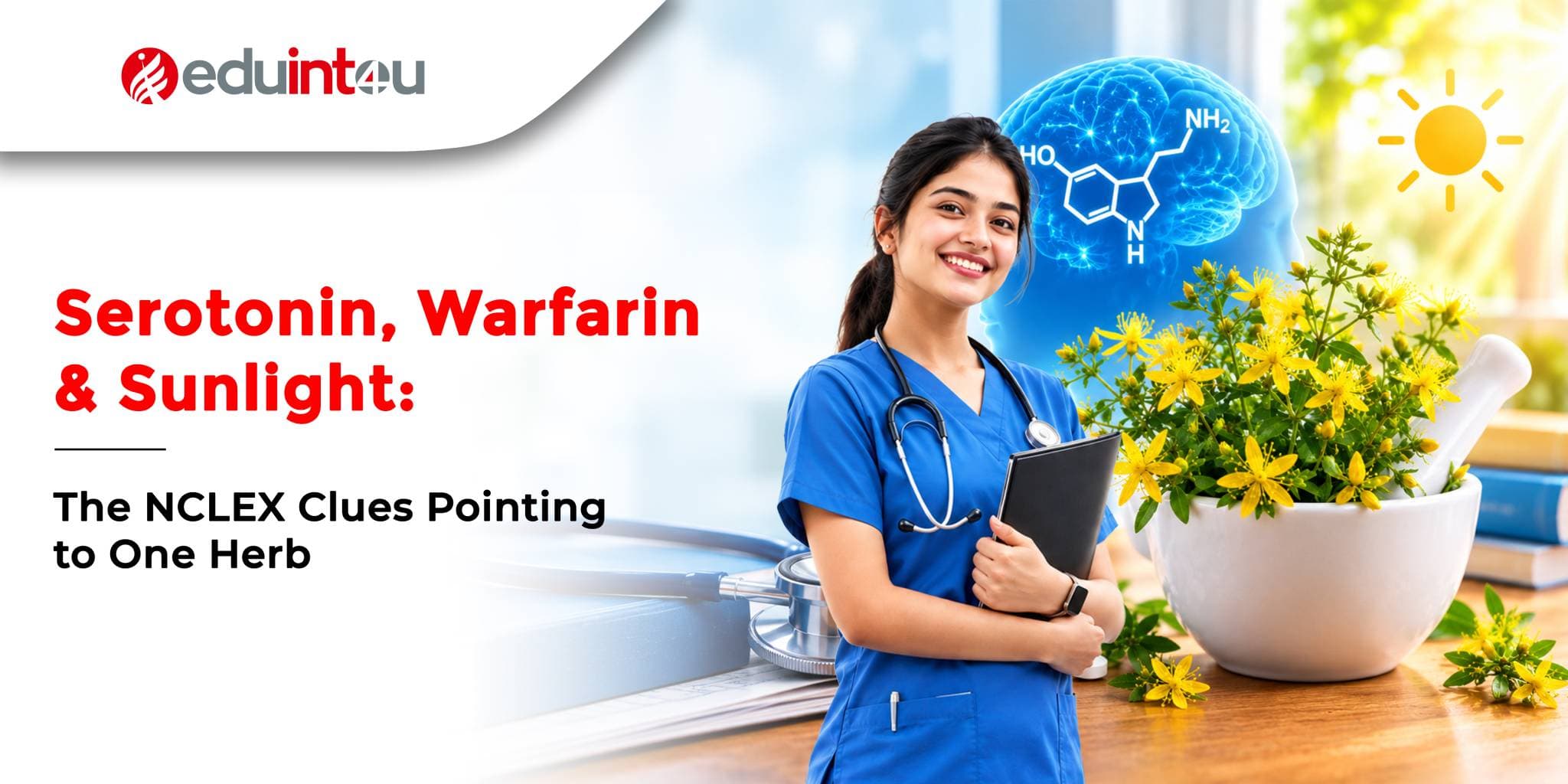
St. John’s Wort and Drug Interactions: An NCLEX-RN Safety Lesson
St. John’s wort is one of those herbal products that can look harmless at first glance but becomes much more important when you understand its interactions with medications. For nursing students and NCLEX-RN candidates, it is a particularly useful example of why medication questions are not always about recognizing prescription drugs alone.
Think back to this question:
An herbal product is being taken by a patient who also uses an antidepressant. The nurse is concerned about serotonin-related effects. The same herbal product may reduce the effectiveness of warfarin and can increase sensitivity to sunlight.
What is the herbal medication?
The answer is St. John’s wort (Hypericum perforatum).
But identifying the herb is only the beginning. The more important nursing lesson is understanding why this herbal product matters, what interactions it can cause, and how a nurse should recognize the associated safety concerns.
The Herbal Product Hidden in the Clues
St. John’s wort has traditionally been used for a variety of purposes and is widely promoted for symptoms of depression. However, its interaction profile is one of the major safety concerns associated with the herb.
Current guidance from the National Center for Complementary and Integrative Health (NCCIH) highlights that St. John’s wort can interact with a wide range of medicines, sometimes reducing their effectiveness and, with certain medications, increasing the risk of serious adverse effects.
That makes St. John’s wort a valuable topic for NCLEX-RN preparation, because the question may not directly ask, “What is St. John’s wort?” Instead, the exam may describe the interaction and expect the candidate to connect the clues.
One Herb, Several Nursing Safety Concerns
The first major clue is its interaction with certain antidepressants and other medicines that affect serotonin.
Combining St. John’s wort with certain antidepressants can increase serotonin-related effects and potentially lead to serotonin syndrome, which can become serious.
For an NCLEX-RN candidate, this is where clinical judgment becomes important. Rather than memorizing the herb as an isolated fact, connect it with the underlying safety concept:
St. John’s wort + certain serotonergic medications = concern for excessive serotonin effects.
A patient taking an herbal supplement should therefore not be assumed to be medication-free. Herbal products can have pharmacological effects and can interact with prescription medicines.
Why Warfarin Appears in the Question
The second major clue is warfarin.
St. John’s wort can reduce the effectiveness of warfarin and has been documented as a clinically significant drug interaction. NCCIH identifies warfarin among medications whose effects may be weakened by St. John’s wort.
This is particularly important because warfarin has a narrow therapeutic range, meaning changes in its effect can have important clinical consequences. NCCIH specifically recommends that people taking medications such as warfarin tell their healthcare providers about herbal supplement use.
For nursing students, the key takeaway is not simply to memorize “St. John’s wort lowers INR.” The safer clinical approach is to recognize that St. John’s wort can reduce warfarin’s anticoagulant effect, making monitoring and professional review important.
This is exactly the type of connection that can make medication questions easier to understand during NCLEX-RN preparation.
The Sunlight Clue Is Not Random
The third clue is photosensitivity.
St. John’s wort can increase sensitivity to sunlight, particularly at higher doses, and severe skin reactions following sun exposure are a recognized safety concern.
This gives nursing candidates another memorable association:
St. John’s wort → increased sensitivity to sunlight.
When several apparently unrelated clues appear in the same question — serotonin-related effects, reduced medication effectiveness and photosensitivity — they can point toward the same herbal product.
That is why learning through clinical connections can be more effective than memorizing isolated lists.
Why “Natural” Does Not Automatically Mean Safe
One of the biggest lessons behind this topic extends beyond St. John’s wort.
Patients may sometimes assume that an herbal supplement is safer simply because it is described as natural. However, herbal products can contain biologically active substances and can interact with prescription and over-the-counter medications.
NCCIH notes that St. John’s wort has a high potential for drug interactions, including through effects on drug-metabolizing enzymes and intestinal P-glycoprotein.
For nurses, this means medication history should not stop at prescribed medicines.
A patient may say, “I am not taking any medications,” and then mention an herbal supplement later. Asking about herbal products, vitamins, supplements and over-the-counter medicines can therefore be an important part of obtaining a complete medication history.
Think Like a Nurse, Not Just Like a Test-Taker
A strong NCLEX-RN preparation strategy involves moving beyond memorization.
Imagine a patient tells you:
“I take an herbal supplement for my mood, and I also take an antidepressant.”
The strongest nursing response is not to ignore the information because the supplement is herbal. The nurse should recognize that an interaction may exist and ensure the patient’s medication and supplement use is appropriately reviewed.
Similarly, if a patient taking warfarin reports using St. John’s wort, that information deserves attention because of the potential reduction in warfarin effectiveness.
The exam may test this through a medication question, a priority question, a patient-teaching scenario or a clinical judgment case. The surface of the question may change, but the underlying safety principle remains the same.
A Small Memory Connection for NCLEX-RN Candidates
If you want a simple way to remember this herb, connect the three major clues instead of memorizing the name alone.
Think:
St. John’s wort → serotonin concerns → warfarin interaction → sunlight sensitivity.
Once those associations are connected, an unfamiliar-looking question becomes easier to decode.
This type of learning is particularly useful when preparing for the current NCLEX-RN, where candidates need to apply knowledge to patient situations rather than rely entirely on simple recall.
What Else Should You Know About St. John’s Wort?
The interaction list does not end with antidepressants and warfarin.
St. John’s wort can affect the effectiveness of several medicines, including certain birth-control pills, cyclosporine, digoxin, some HIV medications, some cancer medications and certain statins.
This broad interaction profile is one reason healthcare professionals should be told about all supplements a patient is taking.
The appropriate response is not to assume that every herbal product is dangerous. Instead, nurses should recognize that specific herbs can have specific pharmacological effects and clinically important interactions.
How This Connects to Clinical Judgment
The current NCLEX-RN places strong emphasis on clinical judgment. A question about St. John’s wort can therefore test more than simple identification.
You may need to recognize a risk, interpret patient information, identify which medication combination requires attention or determine what additional assessment or action is appropriate.
The deeper skill is understanding the relationship between the patient, medication, supplement, interaction and potential adverse effect.
That is the kind of reasoning that turns a memorized fact into practical nursing knowledge.
How Eduint4u Supports NCLEX-RN Preparation
At Eduint4u, NCLEX-RN preparation is designed around more than simply remembering large numbers of medication names.
Nursing candidates need to understand why an intervention is appropriate, how medications interact, which patient findings matter most and how clinical information connects to safe nursing decisions.
Topics such as herbal-drug interactions can therefore become valuable preparation opportunities. A candidate who understands why St. John’s wort can create medication-safety concerns is better positioned to approach related questions even when the wording changes.
Eduint4u supports candidates through NCLEX-RN-focused learning and preparation, helping them strengthen nursing knowledge, question-solving ability and clinical reasoning for the examination.
Whether your long-term goal is professional registration in Canada, planning a pathway connected to Canada PR or Canada immigration, or exploring nursing opportunities in another destination such as Australia, strong nursing fundamentals remain an important part of your professional journey. Licensing and immigration requirements vary by destination, so candidates should always check the requirements of the relevant regulatory and government authorities.
The Real Lesson Behind This Herbal Medication Question
The answer to the original question is St. John’s wort.
But for a future RN, the more valuable lesson is everything behind that answer.
An herbal product can interact with prescription medicines. A patient may not consider a supplement to be a medication. A drug interaction can change treatment effectiveness. And a seemingly simple clue such as sunlight sensitivity can become an important piece of the clinical picture.
That is why medication safety is not just about memorizing drug names.
It is about recognizing connections.
And when you can connect the herb, the medication, the interaction and the patient risk, you are not just preparing for an NCLEX-RN question — you are developing the clinical thinking expected of a nurse.
Frequently Asked Questions
Is St. John’s wort safe to take with antidepressants?
St. John’s wort can interact with certain antidepressants and other medicines that affect serotonin, potentially increasing serotonin-related adverse effects. Patients should discuss herbal supplement use with their healthcare provider before combining it with prescription medicines.
Why is St. John’s wort important in NCLEX-RN preparation?
St. John’s wort is a useful NCLEX-RN topic because it connects several important nursing concepts, including herbal-drug interactions, serotonin-related effects, medication effectiveness and photosensitivity. Questions may test these concepts directly or through a patient-safety scenario.
Can St. John’s wort affect warfarin?
Yes. St. John’s wort can weaken the effects of warfarin and is recognized as a clinically important interaction. Anyone taking warfarin should inform their healthcare provider about herbal supplements they use.
Educational note: This article is intended for nursing education and NCLEX-RN preparation. It does not replace individualized medical advice. Patients should consult an appropriately qualified healthcare professional before starting, stopping or combining medicines and herbal supplements.
Sign up for free expert consultation
Popular Post
-
Indian Nurses: Discover the Fastest Route to Canadian RN Registration Without Unnecessary Delays
-
Is IELTS Required for AHPRA Streamlined Nursing Registration?
-
New Brunswick, Canada Nurse Recruitment Event UAE & Qatar for Nurses and Other Professionals
-
NURSES TO AUSTRALIA DIRECT AHPRA PATHWAY - NO NCLEX & NO OSCE
-
A Golden Route for GNM Nurses: Become an LPN in Canada Without IELTS or OET
-
Canada PR for Teachers in 2025: Your Guide to Express Entry & the New Education Category

Eduint4u is your one-stop consultancy providing top-notch NCLEX-RN Coaching and Nursing Licensing process

Location
Copyright © 2025 eduint4u. All rights reserved.